
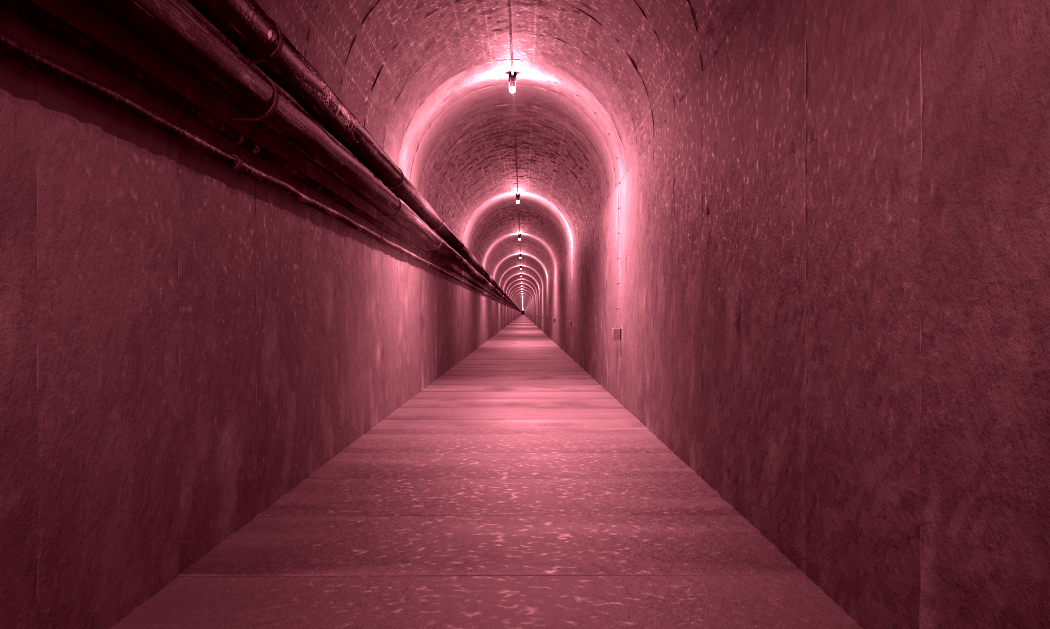
Image (cropped and colourised with GIMP image editor) by Matthias Wewering via Pixabay
The Billionaires Will Eat Themselves
By Charlie Fish
The hypnotic strains of Bach’s Prelude in D Minor were interrupted by the captain’s voice. “Final approach to the Nevada Test Site. Landing in four minutes.”
Obit Hardcastle grunted awake, removed his earbuds, and allowed the stewardess to manoeuvre his wheelchair into the landing position. He was an enormous man. Folds of flesh and cucurbitaceous bulges overflowed the oversized wheelchair; the subjugating aura of his presence extended further still.
Out of the porthole window, he watched the rocky desert rise, beige and black, pockmarked by military paraphernalia. He reflected, for a moment, on how he was feeling. This was a major inflection point – possibly the most significant decision he would ever make. He closed his eyes and searched his soul, but, as always, found no doubt, no anxiety, only the cool breeze of rationality and the thrill of the game.
The G700 private jet landed, and Obit’s staff made the necessary preparations. Eventually, the ramp was lowered, and Obit guided his wheelchair out into the blunt Nevada heat. There were various awkward-looking clusters of personnel, penned in by stiff rows of army officers alongside his own private security. In the middle, there was one chaotic individual, pacing like an excited puppy, dressed in distressed jeans and a Metallica T-shirt, looking wildly out of place.
This was Herc Bone, the wealthiest person in the world.
Obit approached the man, and observed him for a moment. He was smaller than he appeared on television. His hair messier. His smile more idiotic.
The two men shook hands.
“That was a two trillion dollar handshake,” said Herc. “I’m the only trillionaire in history, you know. Between the two of us, we have more than two trillion.”
Obit spoke using an electronic voicebox, in a strained tone. “I seem to be giving quite a large chunk of my share to you.”
“It’s a bargain at half the price. At a tenth of the price.” Herc looked smug. “You look sicker than I thought. I heard rumours, but this is –”
“Tactful, as always. Will that be a problem, for the procedure?”
“Not at all; it’s your brain that counts. But I could swear I saw you on the news just last –”
“Judicious use of a body double. For the cameras. It serves me to have the public believe I’m fit. Stops shareholders from spooking.”
“Neat trick. You’ll want to keep doing that, after the… uh… procedure. Keep up the façade. Keep the proles on their toes.”
Herc climbed into the back of an armoured vehicle, part of a phalanx of similar vehicles. A military escort produced a ramp for Obit’s wheelchair. As they drove, the cars ahead of them stirred up so much dust the view was almost completely obscured.
Herc looked up at Obit and laughed to himself, as if an amusing thought had just occurred to him. The artifice of the gesture was transparent. “I got the commander of this base to show me the Area 51 aliens, you know,” said Herc. “The real deal.”
Obit responded with a silent glare.
“Only kidding,” said Herc. “I’m pretty sure the aliens are stored elsewhere. I heard they –”
“I have a question.” It sounded like a command. Even Herc Bone, so accustomed to being the centre of attention, could not help but pay attention when Obit Hardcastle demanded it.
“What?” asked Herc.
Obit’s electronic voice sounded even more strained over the thrum of the engine. “When will you undergo the procedure yourself?”
“Tonight! If all goes well, I’m going in with you! You see, I built 20 chambers, specifically for the 20 wealthiest people in the world. There’s just you left, and number 20 is for me.”
“Just me left?”
“What made you crack? I’ve been trying to persuade you to do this for years.”
Obit did not answer. He looked out the window and saw that they were approaching Bald Mountain, looming like a spectre through the dust. His final destination.
He closed his eyes for a moment and pictured his childhood home in Manhattan, surrounded by art deco buildings and colourful murals, the hum of traffic and the rattle of the el train. He remembered meeting his father in the lobby of the New York Stock Exchange, learning from him how to read people by their body language, the saccades of their eyes, blinking speed, posture, hand placement, vocal pitch – anything but what they were actually saying.
Obit opened his eyes again and studied Herc Bone’s slipshod figure. He was certainly hiding something.
The convoy of armoured vehicles stopped, and the two men disembarked. A high security fence surrounded the base of Bald Mountain, with armed guards posted at regular intervals. Leaving most of their entourage outside, Herc and Obit were escorted through the only gate, through to a giant metal door set into the side of the mountain.
The door opened, slow and massive like a tectonic plate, admitting the men into the bowel of the mountain. They proceeded through a seemingly never-ending corridor, segmented by security doors that were each more elaborate than the one before. Retinal scans, fingerprint scans, voice recognition, airlocks that weighed you and analysed the chemical composition of your exhalations. By degrees, the corridor became dimmer and narrower until Herc no longer had space to walk alongside Obit’s wheelchair.
Finally, they reached their destination.
“This is the dead centre of the mountain,” said Herc. “The peak is nearly 10,000 feet above our heads. And this elevator here will take us another thousand feet down. It could be raining nukes and you wouldn’t spill your cereal. And it’s the perfect, stable temperature for the data centre cluster.”
“The whole cluster is a thousand feet beneath us?” asked Obit.
“A real feat of engineering. I designed it myself. Nobody else could have done it,” Herc said, proudly. With a gesture, he dismissed the remaining military and private security escort. “As agreed, only us and our lawyers from here.”
Obit nodded. Obit’s lawyer wasn’t really a lawyer, of course, but ex-CIA, trained as a foreign intelligence operative, and had mastered six languages and seven martial arts. No doubt Herc’s lawyer had never sat an LSAT either.
Herc, Obit, and the two lawyers entered the cramped elevator, and started descending.
Obit cleared his throat. “Is sex possible?” he said.
“What?” asked Herc.
“After the procedure.”
Herc became animated as he explained. “You’re given a kind of body in there, you know, to help manage all the psychological side-effects, like phantom limb pain, asomatognosia, somatoparaphrenia, derealisation. It’s not a real body, but you’ll perceive it that way, which means you can do what you like with it. You read about that, of course. But what you didn’t read about is, yes, sex’ll feel great. And because it’s simulated, kind of, you can have sex with whoever you want.” He repeated the last with a sinister intonation that made Obit’s throat hitch in disgust. “Whoever you want.”
Obit’s ears popped. The elevator slowed to a halt, announcing its arrival with a cheery ping. Herc looked at his watch. “Right on time.”
The doors opened to an enormous circular room, brightly lit, empty but for a conference table in the middle. As Obit wheeled himself in, he noticed that the room wasn’t actually circular, but a shape with many sides – 20 sides, he deduced, one for each of the numbered chambers.
Herc removed one of the chairs around the conference table so Obit could approach with his wheelchair. Herc sat next to him; the two lawyers stood behind. The other 18 seats were empty, but each place had a monitor, situated so each screen could be seen by every other screen.
Herc pushed a piece of paper in front of Obit. “This is the final piece of the contract. The final commitment. The text is the same you saw before.”
“My people reviewed 87,000 pages.” Even through his electronic voicebox, the sarcasm came through.
“And billed you for every one, I guess.”
“They’re salaried.”
“Of course.” Herc tapped the page. “This is the page that matters. By signing this, you legally transfer your personhood, and all your assets, to the digital instance created in this data centre.”
“And this?” asked Obit, pointing at his own chest.
“Obsolete hardware.” Herc smiled. “But before you sign, we’re just in time to meet the others.”
He touched a button under the table, and all 18 monitors flickered into life. Obit recognised the faces of some of the richest men in the world.
Marinelli Lanza, European luxury goods billionaire, was the first to speak. “Obit Hardcastle! I don’t believe it.”
“You’re finally joining us?” said Hong Jin, who had made his megafortune manufacturing computer chips.
“Decided you want to live forever?” asked the oil emperor Orman Mambani.
The chatter continued, while Herc wore an indulgent expression and Obit remained silent. Eventually, Herc raised his hand, and the assembled tycoons fell silent. “Obit,” said Herc. “Do you have any final questions?”
“Yes,” said Obit, looking directly at Herc. “Why would you show me the others? To show me two or three was necessary to persuade me of the legitimacy of the procedure, but is it not in your interest, and theirs, to keep secret that they have all already undergone the procedure? Are they not still publicly assumed to be walking around in the flesh?”
Herc smiled wryly. “You’re the last one. No need for secrets between us anymore. And you know me, I can’t help but boast.” He held out a pen.
Obit’s lawyer leaned over to read the brief contract addendum, and nodded.
Obit took the pen. Again, he spoke directly to Herc. “I still don’t trust you. Or this procedure. But I’m dying. I’ve got nothing to lose.”
He signed. All the faces on the monitors applauded. Herc was either dancing or having a seizure, Obit couldn’t tell for sure.
“Welcome to forever,” said Herc, once he had calmed down enough to speak. He pointed to one of the chamber doors. The one marked 20. Obit moved his wheelchair over to it, while Herc entered a complicated code into a keypad.
Herc walked over and pulled open the thick steel door, which wouldn’t have looked out of place in a bank vault. “This is the last time this door will ever open. I’ve set the time lock for ten thousand years. Let’s get you plugged in. Let’s get your consciousness into the machine.”
Obit wheeled towards the door. He could see, inside, what looked like an MRI machine connected to a bank of servers. At the threshold, he hesitated.
Herc beckoned for him to come in. “Oh, don’t worry,” he said. “The technology is entirely self-maintaining, with quadruple redundancies. The power uses geothermal primary with nuclear backup. It could last a hundred thousand years. It could last –”
“I thought you reserved the last chamber for yourself?”
“What?” asked Herc.
“You said you had number 20.”
Herc smiled. “No, I’ve got number 1,” he said. But Obit did not hear, because he was concentrating on Herc’s body language, the saccades of his eyes, the pitch of his voice, the placement of his hands. He thought back over the last few days. Herc’s demeanour always seemed so cavalier, but it was calculated. He was a smart man. Ruthless.
“It’s a scam, isn’t it?” said Obit.
Herc laughed. “It’s natural to –”
“Does the technology even exist?” Obit had spoken quietly, yet with such force that Herc froze.
After a moment, Herc laughed again and walked around to the back of the wheelchair, intending to push Obit into the chamber – but the brakes were solidly applied. Obit looked up at him with a fierce expression.
“What happens if I refuse to go in,” said Obit, his electronically assisted voice sounding like rocks scraping together.
Herc looked over to the two lawyers, still standing by the conference table, and positioned himself so the lawyers would not be able to see his face. “It’s too late,” said Herc. “You signed the transfer of personhood. Legally, you aren’t you anymore.”
“Right,” said Obit. “Legally I am now embodied in the servers into which you promised to upload my consciousness. The servers you sold to me. But now, if you don’t upload my consciousness, what then?”
“Now, Obit, I –”
“And the others. Did you really upload their consciousnesses? Are they really living in these chambers?”
Herc’s expression changed. He signalled across the room to his lawyer, who immediately pulled a gun that he’d managed to smuggle through all the security checks – of course, though Obit, even the security checks were a sham – and shot Obit’s lawyer between the eyes.
“You had to make it difficult,” said Herc, almost with indifference.
Obit wheeled back into the middle of the room, ignoring the gun now pointed at him, and leaned over to look at his lawyer bleeding out on the floor. “Goodbye, friend,” he said, the electronic voicebox flattening his emotions.
Herc crossed the room and slouched into the chair at the head of the conference table. The monitors were blank now. “You’re the only one who figured it out.”
Obit looked at the gun pointed at him by Herc’s so-called lawyer. He needed to play for time. “You killed them all.”
“Every single one of them signed over their personhood to these servers, so I didn’t really kill any of them. Just disposed of their bodies.”
“What’s really on the servers?”
Herc laughed. “Nothing! I sold them to you lot, after all.”
“So whom did I speak with?” asked Obit, gesturing at the monitors.
“I fed thousands of hours of footage of each of them into a neural network. It simulates them just well enough to make the occasional public appearance on TV, attend board meetings, persuade the next billionaire to sign everything over to me. Glorified chatbots.”
Obit knew there was no way he could escape, but perhaps he could grab the contract from the table and destroy it. Reclaim his personhood. He guided his wheelchair closer, on the pretence of making better eye contact with Herc.
Herc kept talking. “I did try to upload a human consciousness into a computer, but it can’t be done. Then I came up with this plan instead. I now control nearly six trillion dollars of assets. Including yours. In terms of GDP, there’s USA, then China, then me. If my candle must be short, let its flame be blinding.”
Obit leaned forward, carefully judging how close he would have to be to reach out and snatch the contract. Could he create a momentary distraction somehow?
“What do you intend to do with it all?” asked Obit, glaring intensely at Herc.
Herc stood up, walked over to his lawyer and took the gun.
“Whatever the hell I want,” he said, and shot Obit between the eyes.
——–//——–
Charlie Fish is founder and editor of literary magazine Fiction on the Web. His own short stories have been published internationally, including by the British Library, East of the Web, and Mechanics Institute Review. He is also screenwriter of award-winning short films such as The Man Who Married Himself. He can be contacted on charlie@fictionontheweb.co.uk or on Bluesky @charliefish.bsky.social